

Every engineering fresher eventually faces the same question: which CAD software should I learn first? The answer isn’t one-size-fits-all — it depends entirely on the industry you’re targeting. Here’s a definitive breakdown for 2026.
The Three Dominant Platforms
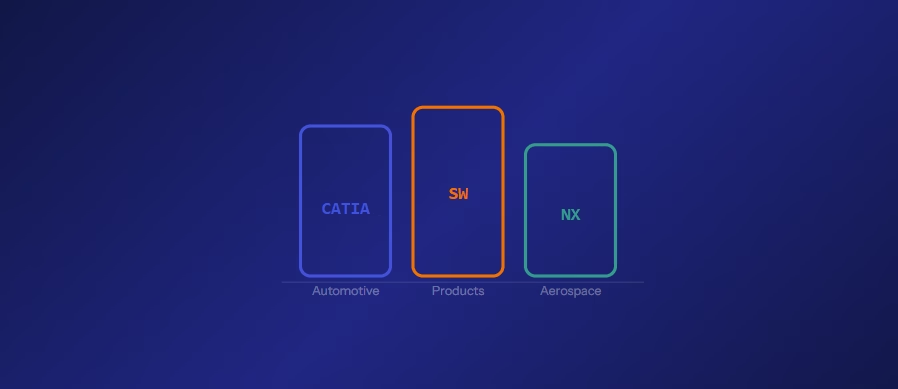
| Tool | Primary Industry | Key Strength | Typical Hiring Companies |
|---|---|---|---|
| CATIA V5/V6 | Automotive OEMs, Tier-1 suppliers | Surface modelling, complex assemblies | Tata Motors, Mercedes-Benz India, VW, Mahindra |
| SolidWorks | Product design, consumer goods, SMEs | Ease of use, simulation integration | Kirloskar, Finolex, mid-market manufacturers |
| NX (Unigraphics) | Heavy engineering, aerospace, defence | CAD-CAM integration, large assemblies | HAL, ISRO vendors, L&T, Thermax |
If You’re in Pune — Start With CATIA
Pune’s automotive ecosystem means CATIA is the dominant hiring requirement. Over 70% of automotive design engineer job postings in Pune and Chennai specifically ask for CATIA V5 or V6. If your goal is an OEM or Tier-1 supplier role, CATIA is non-negotiable.
When SolidWorks Makes More Sense
If you’re targeting product design companies, consumer electronics, medical devices, or startups — SolidWorks has a lower learning curve and wider SME adoption. It’s also excellent for building a portfolio quickly because of its intuitive interface and robust simulation tools.
The Smart Strategy: Learn One Deep, Know One Shallow
Industry feedback consistently shows that employers want depth over breadth. A fresher who is genuinely proficient in CATIA (or SolidWorks) will always outshine someone who dabbled in three tools superficially. Pick one primary tool aligned with your target industry, master it with real project work, and then learn the basics of a second tool.
AutoCAD: Don’t Ignore 2D
Regardless of which 3D tool you master, AutoCAD and 2D drawing interpretation remain essential. GD&T-annotated 2D drawings are still the primary communication tool between design and manufacturing teams across all industries.